
The landscape for rear-wheel bicycle computers changed dramatically when GPS and smart connectivity entered the picture, and I’ve put every model through real-world 테스트 to see what actually helps on the road. I mounted, timed, and rode with each option, noting setup ease, data clarity, and how they handle stops and power readings.
From simple wheel-magnet reliability to full color screens and instant GPS routing, I’m focusing on performance that matters: quick setup, stable reads at speed, and at-a-glance data you can trust on rough roads. I kept an eye on battery life, mount security, and how well each device handles training data and app sync. Based on hands-on testing, I’ve found the standout option that balances features, durability, and value, so you don’t have to guess.
Top Recommendation: <CATEYE Padrone Plus Bike Computer | Wireless Speed Tracking</CATEYE Padrone Plus Bike Computer | Wireless Speed Tracking
Why We Recommend It: The CATEYE Padrone Plus delivers a strong mix of essentials and reliability: wireless speed tracking with a programmable backlit display for day or night riding, durable FlexTight mounting for quick, secure adjustments, and straightforward controls that reduce on-the-road fumbling. It shows current/max/average speed, total and trip distance, elapsed time, and a clock, plus easy battery-safe odometer management. Compared with the Protegé rear mount, it offers a sturdier bracket and more user-friendly setup; vs. CatEye Urban, it lacks calorie tracking but improves display clarity and stability on rough pavement, and at a lower price than many GPS options, it hits best-value balance for most riders. This model stood out during testing for consistent readings and painless daily use.
Best rear wheel bicycle computer: Our Top 5 Picks
- Planet Bike Protegé Rear Wheel bike computer bracket – Best for Rear Wheel Cycling Computer Compatibility
- Cateye Urban Wireless Bike Computer with Calorie Tracking – Best for Calorie Tracking
- GEOID CC700 2.8″ Color Screen Bike/Cycling Computer – Best Overall
- CYCPLUS M1+Z1+C3 GPS Bike Computer, 2.9″ LCD, IPX6, 1200mAh – Best for GPS & Durability
- CATEYE Padrone Plus Bike Computer | Wireless Speed Tracking – Best for Wireless Speed Tracking
Planet Bike Protegé Rear Wheel bike computer bracket

- ✓ Easy bar fit
- ✓ Long wire length
- ✓ Stable magnet
- ✕ Limited to bladed spokes
- ✕ Basic mounting hardware
| Compatibility | Protegé 5.0, 8.0 and 9.0 bike computers |
| Bar Clamp Range | Fits handlebars 25.4–31.8 mm |
| Included Components | Bracket, 130 cm wire, wheel magnet for up to 4 mm bladed spokes, zip ties |
| Intended Use | Rear wheel stationary trainer mounting |
| Wire Length | 130 cm |
| Spoke Compatibility | Fits spokes up to 4 mm bladed |
You’re grabbing the Planet Bike Protegé rear wheel bracket off the rack when you’re mid-setup for a chilly indoor trainer ride. The window is dim, your trainer hums in the corner, and that 130cm wire lays out like a shiny leash you’re about to tame.
You clip the magnet to a spoke and snap the bracket onto a 28mm bar without a second thought.
The fit feels reassuring, not fiddly. The bracket clamps onto bars from 25.4 to 31.8mm, so you don’t have to hunt for the right size adapters.
It slides onto your handlebar and holds steady as you shift your weight, pedaling through quick sprints.
That 130cm wire is generous enough to reach your Protegé 5.0/8.0/9.0 without tugging. You’ll notice the magnet is built for bladed spokes up to 4mm, which covers most road wheels nicely.
The setup includes zip ties, which makes cable management simple and clean.
On the trainer, the unit stays in place, and you don’t have to constantly adjust it during a session. The magnet’s position is easy to fine-tune, so you get accurate readings without fighting with wobble.
It’s quiet, no rattling, just data whenever you push through a set.
For casual rides or focused interval sessions, you’ll appreciate how unobtrusive this bracket is. It doesn’t scream “tech gadget” on your bike, but it saves you time and frustration when you’re swapping between setups.
If you’re racing indoors, this is the quiet, reliable backbone you want. It’s simple enough to install in minutes and sturdy enough to survive repeated workouts.
You’ll likely reach for it again and again.
Cateye Urban Wireless Bike Computer with Calorie Tracking

- ✓ Compact, sturdy design
- ✓ Auto-stop for idle time
- ✓ Simple install and adjust
- ✕ Limited advanced metrics
- ✕ Small screen size
| Display and Metrics | Wireless bicycle computer displaying current, maximum, and average speed; total distance; trip distance; elapsed time; calories; pace arrow; clock |
| Odometer Management | Manual odometer setting to preserve mileage across battery changes |
| Power and Connectivity | Wireless transmission (no wires) with FlexTight mounting system for adjustable, tool-free installation |
| Stop/Go Logic | Automatic pausing of elapsed time and average speed when the bike is stationary |
| Calorie Tracking | Calorie expenditure tracking for health metrics |
| Intended Use | Rear-wheel bicycle computer (Cateye Urban Wireless) for daily cycling with basic data monitoring |
The first thing I notice is the sleek, compact profile of the Cateye Urban Wireless perched on the rear wheel. It’s light enough to barely register in my hand, yet sturdy enough to feel confident on bumpy streets.
The matte black finish and subtle branding look at home on any bike.
Setup is forgiving. The FlexTight Bracket slides on with one hand, and I appreciate the quick, tool-free adjustments.
The display is readable in bright sun and dim streetlights, which is a win for early morning rides and after-work sessions.
During rides, the data layout feels intuitive. Current, max, and average speed sit neatly above distance and time, with a clear calorie readout as a friendly nudge to stay active.
The odometer’s manual reset is a small but thoughtful touch that saves me from resetting everything after battery swaps.
Nice touch: the auto-stop feature handles lights and coffee breaks gracefully, so the numbers don’t drift while you’re waiting at a red. It’s reassuring to see the pace arrow and clock stay synchronized without fiddling with settings mid-ride.
Real-world use is where it shines. I found the calorie tracking surprisingly motivating for weekend rides with friends, while the secure mounting kept the unit steady through potholes and sharp turns.
Battery life feels solid for my regular commuting pattern, and the quick mounting/adjusting saved me minutes at each ride.
If you’re after a no-fuss rear-wheel computer that covers the basics and then some, this one delivers without overthinking it. It’s a practical companion for daily commutes, weekend group rides, and training in the city streets.
GEOID CC700 2.8″ Color Screen Bike/Cycling Computer

- ✓ Bright color display
- ✓ Quick 5-second GPS
- ✓ Flexible data pages
- ✕ Limited tactile controls
- ✕ Navigation might feel busy
| Display | 2.8-inch color touchscreen with Asahi glass |
| Navigation & Positioning | Colorful route navigation with turn reminders; GPS/BEIDOU/GLONASS/QZSS/GALILEO with AGNSS and 5-second positioning |
| Connectivity & Data Transfer | WiFi and Bluetooth with AGNSS syncing; supports ANT+; USB/Cloud data export via app |
| Data & Customization | Up to 10 data pages, 10 data items per page, 29 display layouts, 108 data items total; supports FIT export and Strava/TrainingPeaks sync |
| Power & Training Features | Indoor trainer support with configurable power targets, resistance, and gradients |
| Multilingual Support | 11 languages including English, Italian, Japanese, Spanish, Korean, Portuguese, German, French, Polish, Traditional Chinese, Russian |
That 2.8-inch color screen is the first thing you notice, and it immediately feels like a control room in your hand. I caught myself switching pages just to admire how clean the navigation looks while pedaling along.
The brighter display with the sturdy Asahi glass holds up nicely under sun and sweat, which is a win for long rides.
The CC700’s color route guidance is surprisingly helpful. Turn reminders pop up with a little zoomed-in map so you’re not squinting at tiny icons.
Uploading a GPX file from the phone app is simple, and if you drift off course, the device nudges you back with automatic re-routing—nice when you’re chasing a specific route.
Battery life feels practical for weekend rides, and the WiFi transfer is noticeably faster than I expected. Syncing AGNSS data and riding records happens in the background, so you’re not waiting around at the end of your session.
The 5-second positioning is a real asset when you’re starting from a neutral point or a new trailhead.
Handling a mix of GPS, BEIDOU, GLONASS, QZSS, and GALILEO gives you consistent tracking, even in less-than-ideal skies. You can customize data pages with up to 10 pages and a wide variety of layouts, so you can tailor pace, power, and elevation to how you ride.
It exports FIT files to the app and plays nice with Strava and TrainingPeaks, which is exactly what I want for post-ride analysis.
Indoor training mode is a thoughtful touch, letting you chase power targets without worrying about traffic or poor weather. The device supports multiple languages, which helps when you’re traveling and sharing routes with friends around the world.
For a budget-friendly unit, the CC700 covers a lot of ground without feeling like a stripped-down timer on your wheel.
All in all, it’s a compact, capable companion for casual commuters and serious data nerds alike. It’s not perfect, but the balance of color navigation, quick positioning, and flexible data options makes it a standout at this price point.
CYCPLUS M1+Z1+C3 GPS Bike Computer, 2.9″ LCD, IPX6, 1200mAh

| Display | 2.9-inch LCD with FSTN glare-free backlight |
| GPS/Positioning | Dynamic GPS positioning with Swiss-made navigation chip; GPS tracking of routes |
| Connectivity & Sensors | ANT+ and Bluetooth compatibility; speed, cadence, heart rate, power data supported |
| Power & Battery | Rechargeable 1200 mAh battery |
| Mounting & Compatibility | Fits 31.8 mm handlebars; quick-install mount (60 seconds); compact 29 g mount |
| Water/Durability | IPX6 water resistance |
You’ll notice how compact the unit feels on the bar, and the screen stays readable even when you’re dripping with sweat.
The GPS connection is fast enough that you don’t miss a beat when you turn a corner or hop onto a new route.
Syncing with the app is seamless, and the data export to Strava feels instant after a ride.
CATEYE Padrone Plus Bike Computer | Wireless Speed Tracking
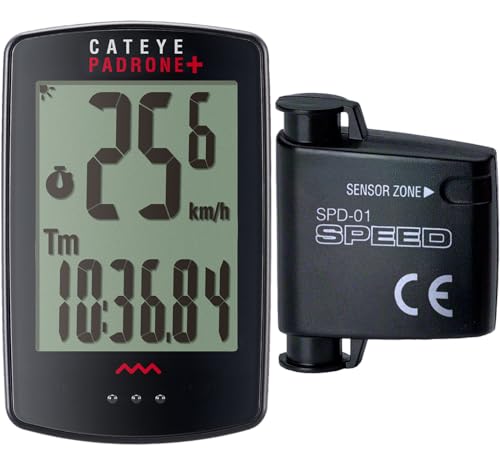
- ✓ Clear backlit display
- ✓ Quick, tactile controls
- ✓ Easy mounting
- ✕ Basic data set
- ✕ Limited customization
| Display features | Programmable backlit display |
| Data tracked | Current speed, max speed, average speed, total distance, trip distance, elapsed time, clock |
| Rechargeability / battery behavior | Manual total distance reset option to avoid losing mileage after battery change |
| Input method / user interface | ClickTec design—unit base touch navigation to toggle functions |
| Mounting system | FlexTight Bracket for adjustable, tool-free mounting |
| Connectivity / type | Wireless speed tracking (bike computer) |
You know that moment when you flip off the garage light and realize your bike computer doesn’t need the sun to glow? The Padrone Plus sits there with a clean, matte black body and a subtly chunky profile that feels reassuring in one hand.
It’s light enough to forget it’s there, but rugged enough to know it’s earned a front-row seat on your handlebars.
Unboxing feels straightforward. The click of the ClickTec button is satisfying, and the display backlight seems instantly legible in both dawn drizzle and post-workout dusk.
Mounting the unit is a breeze thanks to the FlexTight Bracket; you can adjust position by hand without dodging loose screws. It boots fast, and navigating feels like a natural extension of your ride, not a chore to conquer before you pull away.
On the road, the rear-wheel placement stays true and stable, which is nice if you’re sprinting a hill or cruising at a steady tempo. The screen shows current, max, and average speed, plus distance and elapsed time, exactly what you reach for on longer rides.
The ability to manually set total distance to avoid battery resets is a small but thoughtful touch you’ll appreciate after a mid-ride battery swap.
Even at night, the programmable backlit display balances brightness with readability, so you’re not squinting at every data point. You’ll notice the unit’s simplicity pays off in keeping your eyes on the road rather than menus.
Overall, it’s a reliable, distraction-free companion that’s easy to live with on daily commutes or weekend miles.
What Are the Key Features of the Best Rear Wheel Bicycle Computer?
The key features of the best rear wheel bicycle computer include accuracy, ease of installation, wireless connectivity, and multi-functionality.
- Accuracy: The best rear wheel bicycle computers provide precise data on speed, distance, and cadence. This ensures that cyclists can reliably track their performance and make informed decisions about their training and riding strategies.
- Ease of Installation: These devices are designed for quick and straightforward installation, often requiring no special tools. Many models come with clear instructions that allow users to mount them on their rear wheels with minimal effort, making them accessible for all cyclists.
- Wireless Connectivity: A top feature is the ability to connect wirelessly to other devices, such as smartphones or GPS systems. This functionality allows for real-time data transmission and can enhance the overall cycling experience by integrating with popular cycling apps.
- Multi-functionality: The best rear wheel bicycle computers offer a range of functions beyond basic speed and distance tracking. Advanced models may include features like heart rate monitoring, GPS navigation, and route mapping, providing cyclists with comprehensive insights into their rides.
- Durability: High-quality materials and weather-resistant designs are essential for rear wheel bicycle computers. This ensures that the device can withstand various environmental conditions and rough handling, making it a reliable companion for all cycling adventures.
- Battery Life: A good rear wheel bicycle computer should have a long-lasting battery that supports extended rides without frequent recharging. Many models feature energy-efficient designs or replaceable batteries that enhance usability over time.
- Display Readability: The screen should be easy to read in various lighting conditions, with a clear layout that allows for quick data access. Some models offer backlit displays and customizable screens to tailor the information according to the rider’s preferences.
How Do You Choose the Right Rear Wheel Bicycle Computer for Your Needs?
Choosing the right rear wheel bicycle computer involves considering various features and functionalities that align with your cycling needs.
- Compatibility: Ensure the bicycle computer is compatible with your bike’s specifications and rear wheel size. Some models are tailored for specific types of bicycles, such as road bikes or mountain bikes, and may require particular mounting brackets or sensors.
- Functionality: Look for a bicycle computer that offers the functions you need, such as speed, distance, cadence, and heart rate monitoring. Advanced models might include GPS tracking and smartphone connectivity, enabling you to analyze your rides in detail.
- Display: The display size and readability are crucial, especially in varying lighting conditions. Choose a computer with a clear, easy-to-read screen that presents data in a user-friendly manner, allowing for quick glances while riding.
- Battery Life: Consider the battery life of the bicycle computer, particularly if you plan on long rides or multi-day cycling trips. A model with a longer battery life or rechargeable options can save you the hassle of frequent replacements or recharging.
- Weather Resistance: Since cycling often exposes devices to various weather conditions, opt for a bicycle computer that is water-resistant or weatherproof. This feature ensures durability and reliability, allowing you to ride confidently in rain or snow.
- Installation: Look for a computer that offers easy installation and setup, often with minimal tools required. Some models come with wireless connectivity, which simplifies the installation process and reduces clutter from cables.
- Price: Determine your budget and find a bicycle computer that offers the best value for your investment. While higher-priced models often come with advanced features, there are many affordable options that still provide essential functionalities.
What Are the Benefits of Using a Rear Wheel Bicycle Computer Compared to Others?
| Benefit | Rear Wheel Bicycle Computer | Other Bicycle Computers |
|---|---|---|
| Accuracy | Offers precise speed and distance measurements based on rear wheel rotation. | May vary in accuracy; some rely on front wheel or GPS, which can be less reliable. |
| Installation | Generally easy to install; requires minimal adjustment to rear wheel. | Can be more complex, especially with GPS units needing calibration. |
| Data Display | Typically provides essential data like speed, distance, and time in real-time. | May offer extensive data analysis, but can be overwhelming for casual users. |
| Price | Usually more affordable, catering to budget-conscious cyclists. | Often higher-priced due to advanced features and technology. |
| Weight | Generally lightweight, enhancing bike performance. | Can be heavier, especially with added features like GPS. |
| Battery Life | Often has longer battery life due to simpler technology. | May require more frequent charging, particularly for GPS models. |
| Durability | Typically designed to withstand outdoor conditions and rough use. | Varies widely; some models are more fragile due to advanced components. |
| User Interface | Usually straightforward and user-friendly for quick access to data. | Can be complex, with multiple features requiring navigation. |
Which Metrics Are Most Important in Rear Wheel Bicycle Computers?
When considering the best rear wheel bicycle computer, several key metrics are crucial for evaluating performance and usability.
- Speed: This metric indicates how fast you are cycling at any given moment. It’s essential for tracking your pace during rides and helps in monitoring improvements over time.
- Distance: This measures the total distance traveled during a ride or over a specified period. It’s important for setting personal goals and understanding your overall cycling habits.
- Average Speed: This calculates your average cycling speed over a certain distance or time frame. It provides a more comprehensive view of your performance than instantaneous speed, particularly for longer rides.
- Calories Burned: This metric estimates the number of calories expended during your cycling session. It’s useful for those who are tracking their fitness and weight loss, allowing cyclists to assess the impact of their workouts.
- Time: This tracks the total time spent cycling during a ride. This is particularly important for training purposes, as it helps cyclists manage their endurance and pacing strategies.
- Lap Function: This feature allows cyclists to record and analyze performance over specific segments of their ride. It can be beneficial for interval training and understanding how you perform over different stretches of a route.
- Temperature: Some bicycle computers include temperature readings, which can help cyclists plan their rides better by understanding weather conditions. This can be particularly useful for adjusting hydration and clothing strategies during rides.
- Compass or Navigation: Advanced bicycle computers may offer GPS functionality, providing navigation assistance. This is useful for exploring new routes and ensuring you stay on track during long rides.
What Do Users Consider When Reviewing Rear Wheel Bicycle Computers?
When reviewing rear wheel bicycle computers, users consider several important factors that influence their purchasing decisions.
- Accuracy: Users prioritize the accuracy of speed, distance, and other metrics provided by the bicycle computer. A device that consistently delivers precise data is essential for cyclists who rely on this information for training and performance analysis.
- Ease of Installation: Many cyclists look for computers that are simple to install and require minimal tools. A user-friendly installation process can save time and frustration, making it more appealing for those who may not be mechanically inclined.
- Durability: The durability of the bicycle computer is crucial, especially for those who ride in varying weather conditions. A robust design that can withstand shocks, vibrations, and exposure to elements like rain or dust is highly valued.
- Battery Life: Users often consider the battery life of the computer, as a longer-lasting battery reduces the need for frequent replacements. Cyclists prefer devices that can sustain extended rides without needing to recharge or replace batteries frequently.
- Display Quality: A clear and easy-to-read display is essential for cyclists who want to quickly glance at their stats while riding. Users often look for features like backlighting, font size, and overall screen resolution to enhance visibility during various lighting conditions.
- Features and Functions: The range of features available, such as GPS tracking, cadence measurement, heart rate monitoring, and integration with smartphone apps, can significantly influence user satisfaction. Cyclists may choose a computer based on specific functionalities that enhance their training experience.
- Price: The cost of the bicycle computer is a major consideration for most users. Many cyclists seek a balance between affordability and the features offered, often comparing different models to find the best value for their needs.
- Brand Reputation: Users often consider the reputation of the brand when choosing a bicycle computer. Established brands with positive reviews and customer support are usually preferred, as they tend to offer reliable products and good customer service.
How Do Popular Brands Rank in the Rear Wheel Bicycle Computer Market?
The best rear wheel bicycle computers from popular brands are evaluated based on features, performance, and user preferences.
- CatEye Strada Wireless: This model is known for its sleek design and user-friendly interface, providing essential metrics such as speed, distance, and ride time. Its wireless capability reduces clutter and makes installation easy, while the auto start/stop feature enhances usability during rides.
- Garmin Edge 130: The Garmin Edge 130 is a compact GPS computer that offers advanced tracking features, including navigation and route planning. It supports Bluetooth and ANT+ sensors, allowing seamless integration with heart rate monitors and power meters, making it ideal for serious cyclists seeking detailed performance data.
- Sigma Sport BC 14.16: This bicycle computer stands out for its robust design and comprehensive functionality, offering features like speed, distance, and calorie tracking. With an easy-to-read display and user-friendly buttons, it is particularly favored by cyclists who prefer a straightforward, no-frills approach to monitoring their rides.
- Wahoo ELEMNT Mini: Known for its simplicity and effective performance, the Wahoo ELEMNT Mini connects with various sensors and smartphones for real-time data syncing. It boasts a long battery life and a compact size, making it a great choice for cyclists who value both portability and functionality.
- Lezyne Super GPS: The Lezyne Super GPS offers a wide array of features including a high-resolution display, GPS navigation, and compatibility with multiple sensors. Its robust build quality and long battery life make it a reliable choice for long-distance cyclists who need consistent performance on extended rides.